Dallas › Unified Development Code
Chapter 10 — Historic Preservation
§ 10.01
HISTORIC PRESERVATION
Sec. 10.01 – HISTORIC PRESERVATION
1)Purpose
a)In support and furtherance of its findings and determination that the historical, cultural and aesthetic heritage of the City of Dallas is among its most valued and important assets and that the preservation of this heritage is essential to the promotion of the health, prosperity and general welfare of the people;
b)In order to stimulate revitalization of the business districts and historic neighborhoods and to protect and enhance local historic and aesthetic attractions to tourists and thereby promote and stimulate business;
c)In order to enhance the opportunities for federal or state tax benefits under relevant provisions of federal or state law; and
d)In order to provide for the designation, protection, preservation and rehabilitation of historic properties and historic districts and to participate in federal or state programs to do the same;
e)The Dallas City Council hereby declares it to be the purpose and intent of this Ordinance to establish a uniform procedure for use in providing for the protection, enhancement, perpetuation and use of places, districts, sites, buildings, structures, objects, and landscape features having a special historical, cultural or aesthetic interest or value, in accordance with the provisions of the Ordinance.
2)Definitions.
a)Building – A building is a structure created to shelter any form of human activity, such as a house, barn, church, hotel or similar structure. Building may refer to a historically related complex such as a courthouse and jail or a house and barn.
b)Certificate of Appropriateness – Means a document evidencing approval by the Historic Preservation Commission of an application to make a material change in the appearance of a designated historic property or of a property located within a designated historic district.
c)Exterior Architectural Features – Means the architectural style, general design and general arrangement of the exterior of a building, structure or object, including but not limited to the kind or texture of the building material and the type and style of all windows, doors, signs and other appurtenant architectural fixtures, features, details or elements relative to the forgoing.
d)Exterior Environmental Features – Means all those aspects of the landscape or the development of a site which affect the historic character of the property.
e)Historic District – Means a geographically definable area, possessing a significant concentration, linkage, or continuity of sites, buildings, structures or objects united by past events or aesthetically by plan or physical development. A district may also comprise individual elements separated geographically but linked by association or history. A Historic District shall further mean an area designated by the Dallas City Council as a Historic District pursuant to the criteria established in Subsection 10.01(4)b of this Ordinance.
f)Historic Property – Means an individual building, structure, site, or object including the adjacent area necessary for the proper appreciation thereof designated by the Dallas City Council as a historic property pursuant to the criteria established in Subsection 10.01(4)c of this Ordinance.
g)Material Change in Appearance – Means a change that will affect either the exterior architectural or environmental features of a historic property or any building, structure, site, object, or landscape feature within a historic district, such as:
i)A reconstruction or alteration of the size, shape or façade of a historic property, including relocation of any doors or windows or removal or alteration of any architectural features, details or elements;
ii)Demolition or relocation of a historic structure;
iii)Commencement of excavation for construction purposes;
iv)A change in the location of advertising visible from the public right-of-way; or
v)The erection, alteration, restoration or removal or any buildings or other structure within a historic property or district, including walls, fences, steps and pavements, or other appurtenant features, except exterior paint alterations.
h)Object – An object is a material thing of functional, aesthetic, cultural, historical or scientific value that may be, by nature or design, movable yet related to a specific setting or environment.
i)Site – A site is the location of a significant event, a prehistoric or historical occupation or activity, or a building or structure, whether standing, ruined, or vanished, where the location itself maintains historical or archaeological value regardless of the value of any existing structure.
j)Structure – A structure is a work made up of interdependent and inter-related parts in a definite pattern of organization. Constructed by man, it is often an engineering project large in scale.
3)Commission’s Power to Adopt Rules and Standards:
a)The Preservation Commission shall adopt rules and standards for the transaction of its business and for consideration of application for designation of Certificates of Appropriateness, such as by-laws, removal of membership provision, and design guidelines and criteria. The Preservation Commission shall have the flexibility to adopt rules and standards without amendment to this Ordinance. The Commission shall provide for the time and place of regular meetings and a method for the calling of special meetings. The Commission shall select such officers as it deems appropriate from among its members. A quorum shall consist of a majority of the members.
b)Conflict of Interest:
i)Commission shall be subject to all conflict-of-interest laws set forth in Georgia Statues and in the City of Dallas Charters.
c)Commission’s Authority to Receive Funding from Various Sources:
i)The Commission shall have the authority to accept donations and shall ensure that these funds do not displace appropriated governmental funds.
d)Records of Commission Meetings:
i)A public record shall be kept of the Commission resolution, proceedings and actions.
e)City Staffing for the Historic Preservation Commission:
i)The Director of Community Development shall appoint a staff delegate to provide technical and administrative assistance to the Commission. This staff appointee shall remain an employee to the City, and support of the Historic Preservation Commission shall be an ancillary function to the appointee’s primary job responsibilities.
ii)Staff availability to the Commission will be dictated by formal applications for a Certificate of Appropriateness filed with the Community Development Department.
iii)Requests for technical assistance from staff or hired consultants shall be requested by the Commission and approved, denied, or programed based on the availability of department funding, and the availability of staff beyond the appointee’s primary job responsibilities.
iv)Absent a formal application filed with the City, the Commission may request a Special Called Meeting to discuss strategic planning, and rules and policies of the Commission. However, staff availability may be limited, and no official action shall be taken by the Commission until a formal meeting has been scheduled by the City.
4)Recommendation and Designation of Historic Districts and Properties
a)Preliminary Research by the Commission:
i)Commission’s Mandate to Conduct a Survey of Local Historical Resources: The Commission shall compile and collect information and conduct surveys of historic resources within the City of Dallas.
ii)Commission’s Power to Recommend Districts and Buildings to the Dallas City Council for Designation: The Commission shall present to the Dallas City Council recommendations for historic districts and properties.
iii)Commission’s Documentation of Proposed Designation: Prior to the Commission’s recommendation of a historic district or historic property to the Dallas City Council for designation, the Commission shall prepare a Report for Nomination consisting of:
(a)a physical description;
(b)a statement of the historical, cultural, architectural and/or aesthetic significance;
(c)a map showing district boundaries and classification, i.e. contributing, non- contributing, of individual properties therein, or showing boundaries of individual historic properties; and
(d)representative photographs.
b)Designation of a Historic District:
i)Criteria for selection of historic district: A historic district is a geographically definable area, which contains buildings, structures, sites, objects, and landscape features or a combination thereof, which:
(1)has special character or special historic/aesthetic value or interest;
(2)represents one or more periods, styles or types of architecture typical of one or more eras in the history of the municipality, county, state or region; and
(3)causes such area, by reason of such factors, to constitute a visibly perceptible section of the municipality.
ii)Boundaries of a Historic District: Boundaries of a Historic District shall be included in the separate ordinances designating such districts and shall be shown on the Official Zoning Map of the City of Dallas, or in the absence of zoning, on an official map designated as a public record.
iii)Evaluation of properties within Historic District: Individual properties within historic districts shall be classified as:
(1)Contributing (contributes to the district); or
(2)Non-contributing (does not contribute to the district).
c)Designation of a Historic Property:
i)A historic property is a building, structure, site, or object, including the adjacent area necessary for its proper appreciation or use, that possesses significant historical, cultural, architectural, or aesthetic value.
ii)Criteria for selection of Historic Properties: A historic property is deemed worthy of preservation by reason of value to the City of Dallas, the region or the State of Georgia for one of the following reasons:
(a)it is an outstanding example of a structure representative of its era;
(b)it is one of the few remaining examples of a past architectural style;
(c)it is a place or structure associated with an event or persons of historic or cultural significance to the City of Dallas, State of Georgia, or the region;
or
(d)it is the site of natural or aesthetic interest that is continuing to contribute to the cultural or historical development and heritage of the municipality, county, state or region.
d)Requirements for Adopting an Ordinance for the Designation of Historic Districts and Historic Properties:
i)Application for Designation of Historic Districts of Property: Designations may be proposed by the Dallas City Council, the Commission, or:
(1)for historic districts – a historical society, neighborhood association or group of property owners may apply to the Commission for designation;
(2)for historic properties – a historical society, neighborhood association or property owner may apply to the Commission for designation.
ii)Required Components of a Designation Ordinance: Any ordinance designating any property or district as historic shall:
(1)list each property in a proposed historic district of describe the proposed individual historic property;
(2)set forth the name(s) of the owner(s) of the designated property or properties;
(3)require that a Certificate of Appropriateness be obtained from the Commission prior to any material change in appearance of the designated property; and
(4)require that the property or district be shown on the Official Zoning Map of the City of Dallas and be kept as a public record to provide notice of such designation.
iii)Require Public Hearings: The Commission or the Dallas City Council shall hold a public hearing on any proposed ordinance for the designation of any historic district or property. Notice of the hearing shall be published in at least three (3) consecutive issues in the principal newspaper of local circulation, and written notice of the hearing shall be mailed by the Commission to all owners and occupants of such properties. All such notices shall be published or mailed not less than ten (10) nor more than twenty (20) days prior to the date set for the public hearing. A notice sent via the United States mail to the last-known owner of the property shown on the City tax digest and a notice sent via attention of the occupant shall constitute legal notification to the owner and occupant under this ordinance.
iv)Notification of Historic Preservation Division: No less than thirty (30) days prior to making a recommendation on any ordinance designating a property or district as historic, the Commission must submit the report, required in Subsection 4(a)(3) above, to the Historic Preservation Division of the Department of Natural Resources.
v)Recommendations on Proposed Designations: A recommendation to affirm, modify or withdraw the proposed ordinance for designation shall be made by the Commission within fifteen (15) days following the Public Hearing and shall be in the form of a resolution to the Dallas City Council.
vi)The Dallas City Council Actions on the Commission’s Recommendation: Following receipt of the Commission recommendation, the Dallas City Council may adopt the ordinance as proposed, may adopt the ordinance with any amendments they deem necessary, or reject the ordinance.
vii)Notification of Adoption of Ordinance for Designation: Within thirty (30) days following the adoption of the ordinance for designation by the Dallas City Council, the owners and occupants of each designated historic property, and the owners and occupants of each structure, site or work of art located within a designated historic district, shall be given written notification of such designation by the Dallas City Council, which notice shall apprise said owners and occupants of the necessity of obtaining a Certificate of Appropriateness prior to undertaking any material change in appearance of the historic property designated or within the historic district designated. A notice sent via the United States mail to the last-known owner of the property shown on the City tax digest and a notice sent via United States Mail shall constitute legal notification to the owner and occupant under this ordinance.
viii)Notification of Other Agencies Regarding Designation: The Commission shall notify all necessary agencies within the City of Dallas of the ordinance for designation.
ix)Moratorium on Applications for Alteration or Demolition while Ordinance for Designation is Pending: If an ordinance for designation is being considered, the Commission shall have the power to freeze the status of the involved property.
5)Application to Preservation Commission for Certificate of Appropriateness
a)Approval of Material Change in Appearance in Historic Districts or Involving Historic Properties:
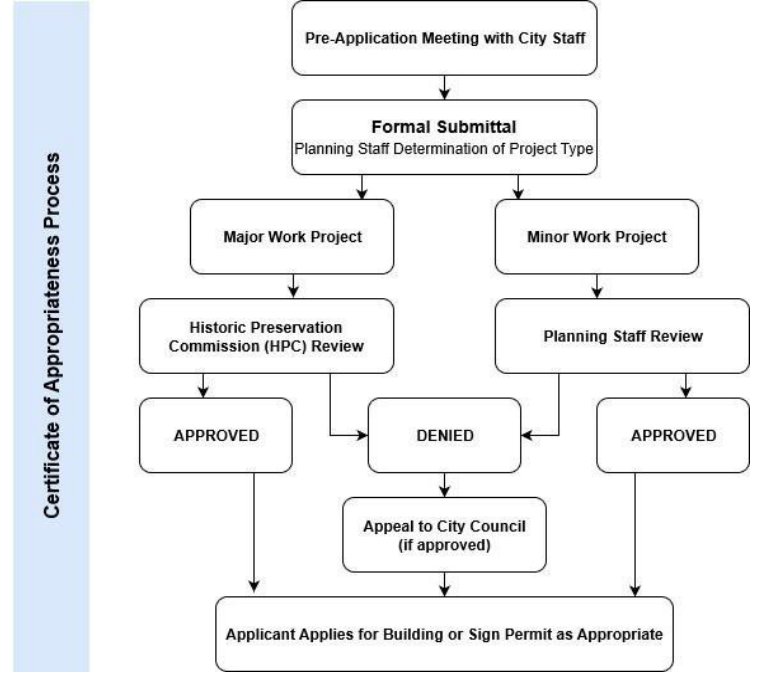
i)After the designation by ordinance of a historic property of a historic district, no material change in the appearance of such historic property, or of a contributing or non-contributing building, structure, site or object within such historic district, shall be made or be permitted to be made by the owner or occupant thereof, unless or until the application for a Certificate of Appropriateness has been submitted to and approved by the Commission. A Building Permit shall not be issued without a Certificate of Appropriateness.
b)Submission of Plans to Commission:
i)An Application for a Certificate of Appropriateness shall be accompanied by such drawings, photographs, plans and documentation as may be required by the Commission.
c)Interior Alterations:
i)In its review of applications for Certificates of Appropriateness, the Commission shall not consider interior arrangement or use having no effect on exterior architectural features.
d)Technical Advice:
i)The Commission shall have the power to seek technical advice from outside its members on any application.
e)Public Hearings on Applications for Certificates of Appropriateness, Notices, and Right to Be Heard:
i)The Commission shall hold a public hearing at which each proposed Certificate of Appropriateness is discussed. Notice of the hearing shall be published in the principal newspaper of local circulation in the city and written notice of the hearing shall be mailed by the Commission to all owners and occupants of the subject property. The written and published notice shall be provided in the same manner and time frame as notices are provided before a Public Hearing for Rezoning.
ii)The Commission shall give the property owner and/or applicant an opportunity to be heard at the Certificate of Appropriateness hearing.
f)Acceptable Commission Reaction to Applications for Certificate of Appropriateness:
i)Evaluation Resources: The Commission may evaluate an application for a Certificate of Appropriateness using the Dallas Design Guidelines for Historic Districts and Sites, adopted on September 2009; Dallas Sign Ordinance; or other historical resource as documented or conveyed.
ii)Commission Action: The Commission may approve the Certificate of Appropriateness as proposed, approve the Certificate of Appropriateness with any modifications it deems necessary, or reject it.
(1)The Commission shall approve the application and issue a Certificate of Appropriateness if it finds that the proposed material change(s) in the appearance would not have a substantial adverse effect on the aesthetic, historic, or architectural significance and value of the historic property or the historic district. In making this determination, the Commission shall consider, in addition to any other pertinent factors, the following criteria for each of the following acts:
(a)Reconstruction, Alteration, New Construction or Renovation: The Commission shall issue Certificates of Appropriateness for the above proposed actions if those actions conform in design, scale, building materials, setback and site features and to the Secretary of Interior’s Standards for Rehabilitation and Guidelines for Rehabilitating Historic Buildings.
(b)Relocation: A Decision by the Commission approving or denying a Certificate of Appropriateness for the relocation of a building, structure, or object shall be guided by:
(i)the historic character and aesthetic interest the building, structure or object contributes to its present setting.
(ii)whether there are definite plans for the area to be vacated and what the effect of those plans on the character of the surrounding area will be.
(iii)whether the building, structure or object can be moved without significant damage to its physical integrity.
(iv)whether the proposed relocation area is compatible with the historical and architectural character of the building, structure, site or object.
(c)Demolition: A decision by the Commission approving or denying a Certificate of Appropriateness for the demolition of buildings, structures, sites, trees judged to be 50 years old or older, or objects shall be guided by:
(i)the historic, scenic or architectural significance of the building, structure, site, tree or object.
(ii)the importance of the building, structure, site, tree, or object to the ambiance of a district.
(iii)the difficulty or the impossibility of reproducing such a building, structure, site, tree, or object because of its design, texture, material, detail, or unique location.
(iv)whether the building, structure, site, tree, or object is one of the last remaining examples of its kind in the neighborhood or the city.
(v)whether there are definite plans for use of the property if the proposed demolition is carried out, and what the effect of those plans on the character of the surrounding area would be.
(vi)whether reasonable measures can be taken to save the building, structure, site, tree, or object from collapse.
(vii)whether the building, structure, site, tree, or object is capable of earning reasonable economic return on its value.
g)Undue Hardship:
i)When, by reason of unusual circumstances, the strict application of any provision of this Ordinance would result in the exceptional practical difficulty or undue economic hardship upon any owner of a specific property, the Commission, in passing upon applications, shall have the power to vary or modify strict provisions, so as to relieve such difficulty or hardship; provided such variances, modifications interpretations shall remain in harmony with the general purpose and intent of said provisions, so that the architectural or historical integrity, or character of the property, shall be conserved and substantial justice done. In granting variances, the commission may impose such reasonable and additional stipulations and conditions as will, in its judgment, best fulfill the purpose of this Ordinance. An undue hardship shall not be a situation of the persons own making.
h)Deadline for Approval or Rejection of Application for Certificate of Appropriateness:
i)The Commission shall approve or reject an application for a Certificate of Appropriateness within forty-five (45) days after the filing thereof by the owner or occupant of a historic property, or of a building structure, site, or object located within a historic district. Evidence of approval shall be by a Certificate of Appropriateness issued by the Commission. Notice of the issuance or denial of a Certificate of Appropriateness shall be sent by United States mail to the applicant and all other persons who have requested such notice in writing filed with the Commission.
ii)Failure of the Commission to act within said forty-five (45) days shall constitute approval, and no other evidence of approval shall be needed.
j)Necessary Action to be Taken by Commission upon Rejection of Application for Certificate of Appropriateness:
i)In the event the Commission rejects an application, it shall state its reasons for doing so, and shall transmit a record of such actions and reasons, in writing, to the applicant. The Commission may suggest alternative courses of action it thinks proper if it disapproves of the application submitted. The applicant, if he or she so desires, may make modifications to the plans and may resubmit the application at any time after doing so.
ii)In cases where the application covers a material change in the appearance of a structure which would require the issuance of a building permit, the rejection of the application for a Certificate of Appropriateness by the Commission shall be binding upon the building inspector or other administrative officer charged with issuing building permits and, in such a case, no building permit shall be issued.
k)Requirement of Conformance with Certificate of Appropriateness:
i)All work performed pursuant to an issued Certificate of Appropriateness shall conform to the requirements of such certificate. In the event work is performed not in accordance with such certificate, the Commission shall issue a cease-and-desist order and all work shall cease.
ii)The Commission and the Dallas City Council shall be authorized to institute any appropriate action or proceeding in a court of competent jurisdiction to prevent any material change in appearance of a designated historic property or historic district, except those changes made in compliance with the provisions of this ordinance or to prevent any illegal act or conduct with respect to such historic property or historic district.
l)Certificate of Appropriateness Void if Construction Not Commenced:
i)A Certificate of Appropriateness shall become void unless construction is commenced within six (6) months of date of issuance. A Certificate of Appropriateness shall be issued for a period of eighteen (18) months and is renewable.
m)Recording an Application for Certificate of Appropriateness:
i)The Commission shall keep a public record of all applications for Certificates of Appropriateness, and or all the Commission’s proceedings in connection with said application.
n)Acquisition of Property:
i)The Commission may, where such action is authorized by the Dallas City Council and is reasonably necessary or appropriate for the preservation of a unique historic property, enter into negotiations with the owner for the acquisition by gift, purchase, exchange, or otherwise, to the property or any interest therein.
o)Appeals:
i)Any person adversely affected by any determination made by the Commission relative to the issuance or denial of a Certificate of Appropriateness my appeal such determination to the Dallas City Council. Any such appeal must be filed with the Dallas City Council within fifteen (15) days after the issuance of the determination pursuant to Section 11.11 – Administrative Appeals Procedure of this Ordinance or, in the case of a failure of the Commission to act, within fifteen (15) days of the expiration of the forty-five (45) day period allowed for the Commission action. Appeals for properties within the City of Dallas shall be made to the Dallas City Council. The Dallas City Council may approve, modify, or reject the determination made by the Commission, if the governing body finds that the Commission abused its discretion in reaching its decision. In order to evaluate an appeal based on an asserted abuse of discretion the Council may but shall not be required to conduct a de novo review of the determination. Appeals from decisions of the Dallas City Council may be taken to the Superior Court of Paulding County in the manner provided by law for appeals from conviction for the City of Dallas ordinance violations.
14)Maintenance of Historic Properties and Building and Zoning Code Provisions
a)Ordinary Maintenance or Repair:
i)Ordinary Maintenance or repair of any exterior architectural or environmental feature in or on a historic property to correct deterioration, decay, or to sustain the existing form, and that does not involve a material change in design, material or outer appearance thereof, does not require a Certificate of Appropriateness.
b)Failure to Provide Ordinary Maintenance or Repair:
i)Property owners of historic properties or properties within historic districts shall not allow their buildings to deteriorate by failing to provide ordinary maintenance or repair. The Commission shall be charged with the following responsibilities regarding deterioration by neglect.
(1)The Commission shall monitor the condition of historic properties and existing buildings in historic districts to determine if they are being allowed to deteriorate by neglect. Such conditions as broken windows, doors and exterior openings which allow the elements and vermin to enter, or the deterioration of a buildings structural system shall constitute failure to provide ordinary maintenance or repair.
(2)In the event the Commission determines a failure to provide ordinary maintenance or repair, the Commission will notify the owner of the property and set forth the steps which need to be taken to remedy the situation. The owner of such property will have thirty (30) days in which to do this.
(3)In the event that the condition is not remedied in thirty (30) days, the owner shall be punished as provided in Chapter XII: Violations and Enforcement of this Ordinance and, at the direction of the Dallas City Council; the Commission may perform such maintenance or repair as is necessary to prevent deterioration by neglect. The owner of the property shall be liable for the cost of such maintenance and repair performed by the Commission.
c)Affirmation of Existing Building and Zoning Codes:
i)Nothing in this Ordinance shall be constructed as to exempt property owners from complying with existing City building and zoning codes, nor prevent any property owner from making any use of this property not prohibited by other statutes, ordinances or regulations.
15)Penalty Provisions
a)Violations of any provisions of this Ordinance shall be punished in the same manner as provided for punishment of violations of validly enacted Ordinances of the City of Dallas.
16)Downtown Dallas Historic District
a)Purpose.
i)In support and furtherance of its findings and determination that the historical, cultural and aesthetic heritage of the city is among its most valued and important assets and that the preservation of this heritage is essential to the promotion of the health, prosperity and general welfare of the people;
ii)In order to stimulate revitalization of the business districts and historic neighborhoods and to protect and enhance local historic and aesthetic attractions to tourists and thereby promote and stimulate business;
iii)In accordance with the ordinance to establish a Historic Preservation Commission in the city; to provide for the designation of historic properties or historic districts;
to provide for issuance of certificates of appropriateness; to provide for an appeals procedure; to repeal conflicting ordinances; and for other purposes; and
iv)The Dallas City Council hereby declares it to be the purpose and intent of this article to designate a historic district in a geographically definable area containing buildings, structures, sites, objects, and landscape features or a combination thereof which has special character or special historic/aesthetic value or interest;
represents one or more periods, styles, or types of architecture typical of one or more eras in the history of the city, the county, the state, or the region; and causes such area, by reason of such factors, to constitute a visibly perceptible section of the City of Dallas.
b)Designation of Historic District and Boundary Description.
i)There is hereby created and designated in and for the City of Dallas the Dallas Commercial Historic District with boundaries as follows: (SEE ORD. NO. 2009-10, 8-3-2009 FOR A MORE COMPLETE LEGAL DESCRIPTION)
c)List of Property in the Historic District and Ownership thereof.
i)There is attached a list of property located within the Dallas Commercial Historic District as created in subsection b hereof, and the owner thereof is set forth beside the name of each property (SEE EXHIBIT “B” ATTACHED HERETO AND IS INCORPORATED HEREIN BY REFERENCE FOR PROPERTY IN HISTORIC DISTRICT AND OWNERSHIP THEREOF).
d)Commercial Historic District Design Guidelines.
i)There is created a Commercial Historic District Design Guidelines for the Dallas Commercial Historic District (See Exhibit “C” ATTACHED HERETO AND IS INCORPORATED HEREIN BY REFERENCE FOR DALLAS COMMERCIAL HISTORIC DISTRICT GUIDELINES).
e)Historic District Boundaries on the Official Zoning Map.
i)Upon designation, the Dallas Commercial Historic District shall be shown on the Official Zoning Map of the City of Dallas and kept as a public record to provide notice of such designation.
f)Certificate of Appropriateness.
i)Upon the effective date of this article, no material change in the appearance of any building, structure, site, object or work of art within the designated Dallas Commercial Historic District shall be made or be permitted to be made by the owner or occupant thereof, unless or until an application for a Certificate of Appropriateness has been submitted to and approved by the Dallas Historic Preservation Commission.
Rebuilt from the published figure · verify at source ↗
CHAPTER XI – PETITIONS, PERMITS, PROCEDURES