A.This Chapter is to assist Paulding County and design professionals regarding turn lane requirements and design guidelines for the installation of left-turn lane and right-turn deceleration lanes for driveways or site roadways accessing a county road.
B.Turn lanes are desirable for the safe execution of speed change maneuvers.
Turn lanes also allow for the storage and protection of turning vehicles, and reducing delays and potential rear-end crashes on roadways while allowing through traffic to pass safely with minimal induced delay.
C.These guidelines provide guidance for developers on what to expect for design and construction requirements on a roadway connecting to their driveway (entrance) when developing a property. This guidance determines:
1.When a turn lane is required to be built as a condition of access to a county road.
2.The required design of the turn lane
520-10.02 Right Turn Lanes Volume Thresholds.
A.A right-turn deceleration lane shall be constructed, at no cost to Paulding County, at each access driveway of the project when the daily site generated Right Turn Volumes (RTV), at that access point, meet or exceed the values shown in Table 1. The estimated daily, site-generated volumes are to be calculated using the most recent edition of the Institute of Transportation Engineers (ITE) Trip Generation Manual and shall be reasonably assigned to the roadway network based on directionality of existing traffic on the County roadway as well and proximity to regional and local trip generators (i.e. employment centers, residential areas, major transportation corridors). If a Development of Regional Impact (DRI) transportation study or traffic impact study is required for the development, that study shall be referenced to demonstrate trip generation, assignment, and distribution.
Table 520.1 Right-Turn Lane Volume Thresholds
Table 520.1
Posted Speed Limit
2 Lane Roadways ADT
4+ Lane Roadways ADT
<6,000
≥ 6,000
<10,000
≥ 10,000
35 MPH or less
150 RTV a day
100 RTV a day
150 RTV a day
100 RTV a day
40 to 50 MPH
100 RTV a day
75 RTV a day
100 RTV a day
75 RTV a day
≥ 50 MPH
75 RTV a day
50 RTV a day
75 RTV a day
50 RTV a day
Also printed with this table — not in the grid, shown as printedverify at source ↗
Limit <6,000 ≥ 6,000 <10,000 ≥ 10,000
B.The Average Daily Traffic (ADT) volumes for the adjacent County roadway to be used in the threshold determination as shown in Table 520.1 must utilize a recent (less than two years), 48-hour, hourly, bi-directional, traffic count. GDOT coverage counts can be utilized if the count station is within ⅓ mile of the study access point and includes actual (not estimated) 48-hour, hourly, bi-directional counts. If no recent counts are available, the applicant is responsible for obtaining new traffic counts (as described above) during appropriate time periods (contact Paulding County DOT for guidance). The roadway ADT utilized in the threshold determination must reflect the opening year of the proposed development. If the project opening date is more than one year away, this roadway ADT must be projected forward (utilizing historical traffic growth calculations and including background traffic from other projects) to the year when the project and its driveway are reasonably expected to finish construction and be open to traffic.
520-10.03 Left Turn Lanes Volume Thresholds.
A.A left-turn lane shall be required at each access driveway when:
1.The access driveway is intersecting a roadway with a current or 3 year projected 6,800 ADT or greater.
2.Is classified as a collector or arterial roadway functional classification as per the State Functional Classification Map.
B.The left-turn lane shall be constructed at no cost to Paulding County.
C.A left-turn lane waiver can be requested for consideration, at each access driveway of the project when the daily site generated Left Turn Volumes (LTV), at that access point are below the values shown in Table 520.2.
D.The estimated daily, site-generated volumes are to be calculated using the most recent edition of the ITE Trip Generation Manual and shall be reasonably assigned to the roadway network based on directionality of existing traffic on the County roadway as well and proximity to regional and local trip generators (i.e. employment centers, residential areas, major transportation corridors). If a Development of Regional Impact (DRI) transportation study or traffic impact study is required for the development, that study shall be referenced to demonstrate trip generation, assignment, and distribution.
Table 520.2 Left-Turn Lane Volume Thresholds
Table 520.2
Posted Speed Limit
2 Lane Roadways ADT
<6,800
≥ 6,800
35 MPH or less
300 LTV a day
200 LTV a day
40 to 50 MPH
250 LTV a day
175 LTV a day
≥ 50 MPH
200 LTV a day
150 LTV a day
E.The Average Daily Traffic (ADT) volumes for the adjacent County roadway to be used in the threshold determination as shown in Table 520.2 must utilize a recent (less than two years), 48-hour, hourly, bi-directional, traffic count. GDOT coverage counts can be utilized if the count station is within ⅓ mile of the study access point and includes actual (not estimated) 48-hour, hourly, bi-directional counts. If no recent counts are available, the applicant is responsible for obtaining new traffic counts (as described above) during appropriate time periods (contact Paulding County DOT for guidance). The roadway ADT utilized in the threshold determination must reflect the opening year of the proposed development. If the project opening date is more than one year away, this roadway ADT must be projected forward (utilizing historical traffic growth calculations and including background traffic from other projects) to the year when the project and its driveway are reasonably expected to finish construction and be open to traffic.
520-10.04 Applicability.
A.Left-turn lanes and right turn deceleration lanes shall be provided at access points on all County roadways as required by these guidelines. However, these guidelines shall not be construed in any manner to allow a left-turn lane into a project where such turning movement is not approved by the County. The requirements and guidelines presented here apply to new intersections and access points on all County roadways. However, Paulding County staff may decide not to require the installation of a left-turn lane on median- divided roadways. If a median break is requested by the developer, meets these left-turn lane thresholds, and is approved by Paulding County DOT, the median break with left-turn lane shall be constructed at no cost to Paulding County. Any new median breaks will need approval from Paulding County DOT Staff.
B.Instances may arise where an existing driveway will be used to access a site/property that will be developed, redeveloped, or expanded. For this situation, if the traffic generated by the existing land use, plus the traffic generated by the new or expanded development, meets the volume thresholds listed above, then a left-turn lane will be required and shall meet the requirements and guidelines contained herein.
C.Dual left-turn lanes may be needed to accommodate high left turning volumes. A capacity analysis should be used to identify the need for dual left-turn lanes. Dual left turn lanes are typically considered when the peak hour left-turn volume is 300 vehicles or greater. However, dual lefts can be considered when peak-hour left-turning volume is less than 300. Paulding County DOT will identify if additional traffic studies are required to determine if dual left-turn lanes are required.
520-10.05 Construction Timing.
Required left-turn lanes and right turn deceleration lanes shall be constructed in conjunction with the development infrastructure and completed prior to the completion of any vertical construction, unless otherwise directed by Paulding County DOT. For phased development projects, the left-turn lane requirement analysis shall be based on full project build-out and, if left-turn lane thresholds are met, shall be constructed prior to the opening of the first (earliest) phase of development, unless otherwise directed by Paulding County DOT.
520-10.06 Coordination with PCDOT.
A development requiring construction of turn lanes on a roadway with a planned Paulding County DOT improvement project is required to coordinate with the Paulding County DOT. At the discretion of the Paulding County DOT and with an approved Development Agreement, an equivalent amount of funds, in lieu of the left-turn lane construction, will be deposited with the Paulding County DOT for its use in the construction of the left-turn lane during the Paulding County DOT improvement project.
520-10.07 Deviations.
A.If an access point does not meet the turn lane thresholds, a turn lane may still be required for project driveways when any of the following criteria are present.
1.Sight distance is limited due to horizontal or vertical curves or other unalterable objects.
2.Intersection skew or other geometric deficiencies exist, as determined by Paulding County DOT.
3.The crash history at that location deems a left and/or right turn lane necessary, as determined by Paulding County DOT.
4.Other safety, geometric, or operational concerns exist at the project location, as determined by Paulding County DOT, that require the installation of a left and/or right turn lane.
B.Paulding County DOT may grant a deviation from these guidelines in part or in whole after determining that any of the following conditions make compliance infeasible:
1.Roadway and driveway geometry does not permit the installation of a left and/or right turn lane or dictates deviations from design standards; or
2.Land use, such as churches or unconventional developments, where the traffic generation patterns do not make the lane warrants applicable; or
3.Existing topographic features would cause construction of a turn lane to be prohibitively expensive, or dictate deviations from design standards; or
4.Roadway features would cause a turn lane to be detrimental to the health, safety and general welfare of the traveling public
5.Other factors indicate that it would be in the best interest of the Department to waive the left and/or right turn lane requirements.
520-10.07 Right Turn Lane Lengths.
A.The design of right-turn lanes shall be in accordance with American Association of State Highway and Transportation Officials (AASHTO) standards and Paulding County DOT and Development Regulations.
Construction, material specifications and workmanship shall conform to Development Regulations, Paulding County, Georgia.
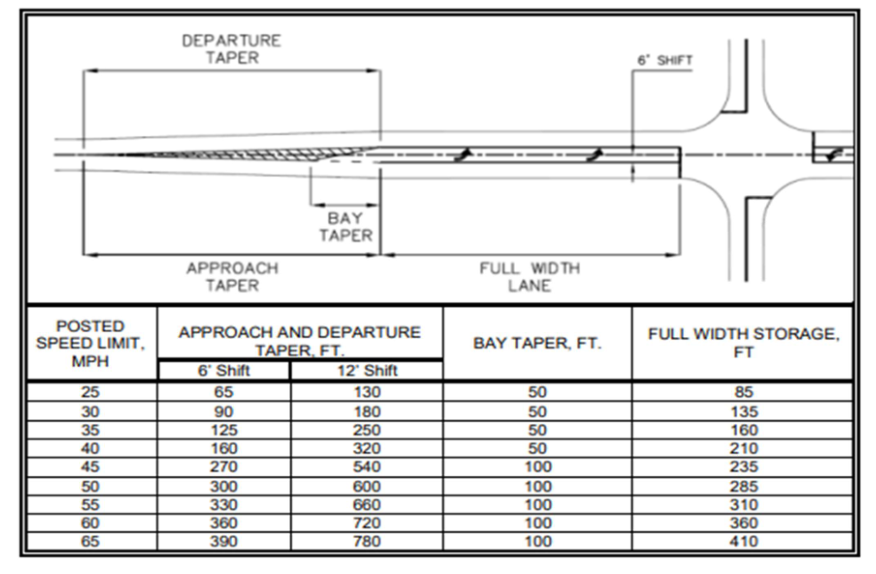
B.Under ideal conditions, right-turn lanes should provide a full-width lane that is long enough to allow for vehicles to decelerate from the operating speed to a full stop and store vehicles waiting to turn. Table 520.3 contains guidelines for lengths of tapers and full-width turn lanes. The taper length in Table 520.3 applies to deceleration right turn lanes only. Guidelines for left turn tapers and lengths are given in Figure 520.1.
C.When traffic studies are conducted, the length of full-width lane needed for storage should be determined. If the length of full-width storage is greater than the length of full-width storage shown in Table 520.3, the longer length should be provided. At signalized intersections, the amount of storage for both right and left turns can be based on the number of vehicles arriving during 1.5 signal cycles. Minimal storage is required for right turn lanes utilizing yield control at unsignalized intersections.
Table 520.3 Right Turn Lane Lengths
Table 520.3
Speed
Full Width Storage
Taper
25 MPH
50 feet
50 feet
30 MPH
75 feet
50 feet
35 MPH
100 feet
50 feet
40 MPH
150 feet
50 feet
45 MPH
175 feet
100 feet
50 MPH
225 feet
100 feet
55 MPH
250 feet
100 feet
60 MPH
300 feet
100 feet
65 MPH
350 feet
100 feet
520-10.08 Left Turn Lane Lengths.
A.The design of left-turn lanes shall be in accordance with American Association of State Highway and Transportation Officials (AASHTO) standards and Paulding County DOT and Development Regulations.
Construction, material specifications and workmanship shall conform to Paulding County DOT and Development Regulations.
B.The design of left turn lanes should consider the intended function and the characteristics of the highway. In many cases, it is necessary to widen the existing roadway to introduce the left-turn lane. In most cases vehicles approaching the turn lane are shifted to the right (especially when using symmetrical widening). The left turning traffic is then shifted back into the lane. Through traffic is returned to its original lane beyond the intersection.
When the highway has a median that is at least 20 feet wide, the left turn lane can typically be developed out of the median, avoiding the need for transitions.
C.The basic design elements of left-turn lanes are illustrated in Figure 520.1. This example shows symmetrical widening, which basically requires the through traffic on each side to shift by one half of the lane width. Some circumstances may dictate that all widening be achieved on one side, which requires a full lane shift for through traffic on the side where the additional width is developed.
Figure 520.1 provides guidelines for selecting the proper length of approach
D.The example shown in Figure 1 has straight-line tapers. These are acceptable but other designs may also be used, including the following:
partial tangent tapers, symmetrical reverse curves, and asymmetrical reverse curves. See the latest edition of AASHTO Green Book for details.
E.The required length of full-width storage shall be based on storage length and a deceleration length that allows vehicles to safely decelerate without a possible conflict with another vehicle. This should be determined by a traffic study. The amount of storage is dependent on the type of traffic control in effect. For signalized intersections, the storage should be sufficient to accommodate the number of vehicles arriving during 1.5 signal cycles, using peak hour volumes. At stop-controlled intersections, the storage is typically based on the number of vehicles arriving during a two-minute period within the peak hour.
Title 3: Chapter 520
520-10.09 Curb and Gutter
Paulding County DOT staff will determine if curb and gutter is required in the construction of left-turn lanes. Curb could be used in developing a raised median on the inside of the lane, or could be necessary on the outside, due to the widening of the existing roadway to accommodate the left turn lane.
520-10.10 Right-of-Way/Easements
Any offsite right-of-way and/or easements required for turn lane construction shall be acquired by the developer at no expense to the County.