The opening pages of this appendix are not in our copy
In the copy of the code we hold, the first two pages of this appendix's text (LDC B:3 and B:4) are printed as pictures with no text, so their words are not in our copy.
Our text begins on LDC B:5, partway through a sentence, exactly as printed. Check the city's official code before relying on anything that may be on the missing pages.
101.8 the ceiling plenum spaces, or the plenum space shall be protected with automatic partial sprinkler protection.
(d)All HVAC units exceeding 5,000 cfm shall be provided with listed smoke detectors installed in the supply system downstream of the filters to detect the presence of smoke and automatically stop the fan(s).
(e)For existing buildings having electrical systems of 277/480 volts with 1,000 amps or more which are designed without ground fault protection and use electric bussway, heat detectors shall be installed in each electrical room to disconnect the overcurrent device supplying that circuit, or shall install ground fault protection. Such modification shall be installed by December 31, 1995.
Exception: Telecommunications equipment buildings, used exclusively for telecommunications equipment and associated generator and power equipment and under the exclusive control of a telecommunications provider shall be exempt from requirements of this section.
101.8. ELECTRIC VEHICLE CHARGING INFRASTRUCTURE READINESS REQUIREMENT FOR NEW COMMERCIAL CONSTRUCTION.
(a)Definitions.
(1)Accessible Electric Vehicle Charging Station ("Accessible Station") means an Electric Vehicle Charging Station where the Electric Vehicle Charging Station is located within accessible reach of a barrierfree access aisle and the Electric Vehicle to enable access and use by persons with disabilities, in accordance with the Americans with Disabilities Act of 1990 (42 U.S.C. § 12101) and the applicable regulations, as amended ("ADA").
(2)Electric Vehicle ("EV") means an automotive-type vehicle for on-road use, including but not limited to passenger automobiles, buses, trucks, vans, neighborhood Electric Vehicles, and electric motorcycles, powered by an electric motor that draws current from a rechargeable storage battery, fuel cell, photovoltaic array, or other source of electric current which is charged by being plugged into an electrical source. For the purpose of this ordinance, off-road, self-propelled Electric Vehicles, such as industrial trucks, hoists, lifts, transports, golf carts, airline ground support equipment, tractors, boats, and similar vehicles are not included in this definition.
(3)EVSE Capable means a parking space that does not yet have an Electric Vehicle Charging Station installed, does have dedicated electrical panel capacity and reserved breaker or subpanel expansion, and some Electric Vehicle Supply Equipment infrastructure installed including, a dedicated branch circuit to provide enough power for future charging stations, one port per parking space with one 9600 VA circuit line provided during construction, or if a dual port is used to supply two adjoining parking spaces, two 9600 VA circuit lines. See Table 1 for a description and visual aid.
(4)Electric Vehicle Charging Station (or "Charging Station") means a public or private parking space that is served by EVSE for charging and parking an Electric Vehicle.
(5)EVSE Ready means an Electric Vehicle parking space that provides dedicated electrical panel capacity, conduit, and wiring installed that terminates at an outlet at the Electric Vehicle parking space but does not yet have an Electric Vehicle Charging Station installed. See Table 1 for a description and visual aid.
(6)Electric Vehicle Supply Equipment ("EVSE") means the conductors, including the ungrounded, grounded, and equipment grounding conductors, and the Electric Vehicle connectors, attachment plugs, and all other fittings, devices, power outlets, or apparatus installed specifically for the purpose of transferring energy between the premises wiring and the Electric Vehicle.
101.8
(7)EVSE Installed means an Electric Vehicle parking space with an Electric Vehicle Charging Station fully installed and operational, including all relevant Electric Vehicle Supply Equipment. The model and manufacturer of the charger may be chosen by the property owner. See Table 1 for a description and visual aid.
(8)NEC means the current version of the National Electrical Code, as published by the National Fire Protection Association.
EVSE Capable Table 1. EVSE Capable, Ready and Installed.
EVSE Ready EVSE Installed Enough electrical capacity is installed at the panel to support future EV charging spots. Additionally, there is a dedicated branch circuit to make sure enough power is available for future charging stations without overloading the system and raceway to future charging spots. Requires panel space and conduit.
A parking space is EVSE Ready Enables immediate EV charg-when additional wiring and a ing to meet current and future junction box or an 8320 VA to demand. Requires installation 9600 VA outlet (like for a clothes of at least a Level 2 EV dryer have been installed). This Charger.
requires dedicated panel capacity, conduit, and wiring that safely terminates at the parking space.
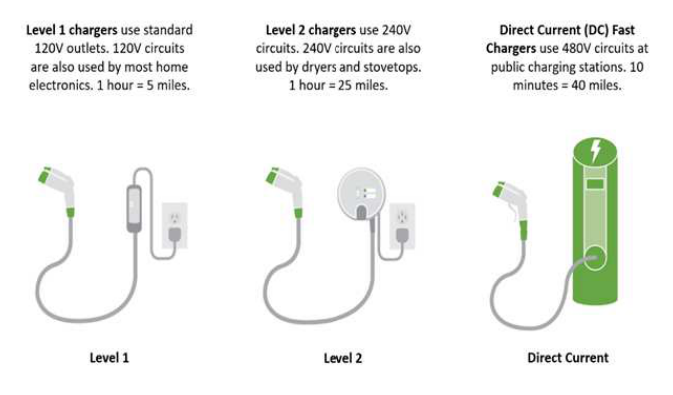
(9)Level-1 Charger means an Electric Vehicle Charging Station with a voltage range from 0 VA to 1920 VA. See Figure 1.
(10)Level-2 Charger means an Electric Vehicle Charging Station with a voltage range from greater than 4800 VA to 9600 VA. See Figure 1.
(11)Level-3 Charger means a Direct Current (DC) Electric Vehicle Charging Station with greater than 9600 VA. See Figure 1.
Figure 1. Level 1, Level 2, and Level 3 Chargers Described
(12)Non-Electric Vehicle means any motor vehicle that is licensed and registered for operation on public and private highways, roads, and streets that does not meet the definition of Electric Vehicle.
(13)Plug-In Hybrid Electric Vehicle ("PHEV") means an automotive-type vehicle for on-road use, including but not limited to passenger automobiles, buses, trucks, vans, neighborhood Electric Vehicles, electric motorcycles, powered by an electric motor that draws current from a rechargeable storage battery, fuel cell, photovoltaic array, or other source of electric current which is charged by being plugged into an electrical source, and having a second source of motive power such as an internal combustion engine.
(b)Minimum Requirements.
(1)All new occupancy classifications, including all new construction for mixed use zoning classifications and all new S-2 parking garages, including S-2 parking garages associated with other new occupancies classifications, shall meet the requirements for EVSE Capable and EVSE Installed established in this Section, to accommodate the installation of EVSE and Charging Stations.
(2)EVSE shall be installed in accordance with the requirements of the current version of the International Building Code and the following ratios:
(a)The off-street parking provided for all new occupancy classifications parking garages and new S- 2 parking garages associated with other new occupancies shall have EVSE installed at the parking spaces dedicated for the use of the building at the following ratio:
(i)EVSE Capable parking spaces shall comprise 20% (or 1:5) of the required parking spaces.
(ii)EVSE Installed parking spaces shall comprise 20% (or 1:5) of the required parking spaces in addition to EVSE Capable Spaces.
(iii)EVSE Installed parking spaces shall be prioritized over EVSE Capable parking spaces in the case where fire safety requirements limit the number of EV parking spaces.
(iv)EVSE Capable Spaces in new off-street parking areas constructed, owned, or oper-101.8 ated by the City of Atlanta shall comprise 50% (or 1:2) of required parking spaces.
(v)EVSE Installed Spaces in new off-street parking areas constructed, owned, or operated by the City of Atlanta shall comprise 25% (or 1:4) of required parking spaces.
(3)All new off-street parking, or the expansion of the existing footprint of off-street parking for all parking lot occupancy classifications, including additional floors on existing parking decks, shall comply with the EVSE Installed and Capable requirements established in subsection (2)(b) of this section; provided, however, that parking spaces below grade or parking spaces three or more levels above the level of exit discharge shall not be required to comply with the ratio.
(1)EVSE Capable parking spaces shall include a raceway, which is continuous from the branch circuit or feeder panel location to the EVSE parking space. The raceway shall be sized and installed in accordance with the NEC, and shall be at least one inch (1") in size or of a size suitable for the required conductor size. The raceway shall include a pull rope or line installed for future conductor installation, and the raceway sealed and labeled for future use.
(a)The electrical load capacity for the service panel shall be provided on the electrical permit documents to ensure the service panel has adequate electrical load capacity.
(b)The electrical permit documents shall show a 14400 VA, 2-pole single phase, (12480 VA if 3-phase feeder supplied) branch circuit to provide for the future electrical load capacity needed for the required EVSE in accordance with the number of parking spaces established in section 101.8(1)(b).
(c)All VA ratings shall apply the relevant demand factors in accordance with the NEC.
(2)EVSE Installed parking spaces shall include, at the minimum a Level-2 Charger with a minimum load capacity of 9600 VA.
(3)EV Charging Stations equipped with a Level-1, Level-2, or Level-3 Charger are permitted as an accessory use in all zoning districts.
(4)EVSE, including Charging Stations shall be designed, located, and installed to prevent damage and minimize exposure to damage, including, but not limited to vehicle impact protection such as posts or bollards that meet the following standards:
(a)Constructed of steel not less than four inches (4") in diameter and filled with concrete.
(b)Spaced no more than four feet (4') on center between posts.
(c)Set at least three feet (3') deep in a concrete footing not less than fifteen inches (15") in diameter.
(d)The top of the post is not less than three feet (3') above grade.
(e)Located not less than three feet (3') from the EVSE.
(f)Bollard installations in elevated parking deck slabs shall be designed by the applicant's design professional, provided however, the Director may require modifications of the design that ensure the safety the EVSE or the Charging Station.
(g)Other barriers that resist or deflect vehicular impact may be approved when they are designed to provide protection equivalent to the barriers describe in subsections (a) through (e).
101.8
(5)Parking garages of all occupancy classifications and S-2 parking garages associated with other new occupancies that have an electrical equipment room must have dedicated space for the future installation of EVSE in the electrical equipment room.
(a)This space shall be identified on all construction documents submitted for permitting review.
(b)The dedicated space shall comply with the International Building Code requirements regulating working space clearances around equipment, and the requirements governing the entrance to and egress from electrical equipment working space.
(c)During construction of the electrical equipment room, all raceways and conduit installed for the EVSE Infrastructure shall terminate at the space dedicated for the future Electric Vehicle Charging Station.
(d)Prior to the final electrical inspection approval, the space dedicated within the electrical equipment room for the future EVSE Capable and EVSE Installed shall have the distribution board installed for "FUTURE ELECTRICAL VEHICLE CHARGING EQUIPMENT AND PANELS."
(d)Fire Protection Standards.
(1)EV parking spaces and Charging Stations shall be accessible from Fire Department standpipes to aid in suppressing fires.
(2)All closed and enclosed parking structures renovated, or constructed after the effective date of this section shall provide one (1) nine meter by six meter (9x6) fire blanket in a location approved by the Fire Chief or their designee. All fire blankets shall be installed and maintained at the building owner's expense.
(3)All closed and enclosed parking structures renovated or constructed after the effec-tive date of this section, shall provide a fused, emergency disconnect for each charging unit to shut down power to the EVSE in the immediate vicinity of the unit.
(a)The location of the disconnect shall be approved by Fire Chief or their designee.
(b)Disconnect devices and related appurtenances shall be installed and maintained at the building owner's expense.
(c)When the EVSE disconnect is installed, the disconnect shall be copper from the service panel to the disconnect. The conductors from the disconnect to the EVSE shall be copper.
(4)A minimum of two (2) 2A:10B:C Fire Extinguishers shall have the minimum capacity of 10lbs and shall be installed within 75 feet of each EVSE capable and installed parking space and in each electrical room servicing EVSE equipment. All fire extinguishers shall be installed and maintained at the building owner's expense.
(5)All closed and enclosed parking structures renovated or constructed after the effective date of this section, shall include an additional 30 inches of space between each EV parking space, or the width of the emergency disconnect, whichever is greater. The spaces in between these parking spaces shall be striped in red to prohibit parking in that space.
(e)Compliance with the Americans with Disabilities Act.
(1)All EVSE and Charging Stations shall comply with ADA regulations.
(2)A minimum of one (1) EVSE Installed Accessible Station shall be located immediately adjacent to an ADAdesignated space to provide access to the charging station.
101.8
(3)An EV Charging station designated as dual-port may serve both an Accessible Station and a non-accessible Charging Station with ADA compliant hardware.
(4)The use of a parking space for accessible parking shall be prioritized over the need to use the space as an EV Charging Station.
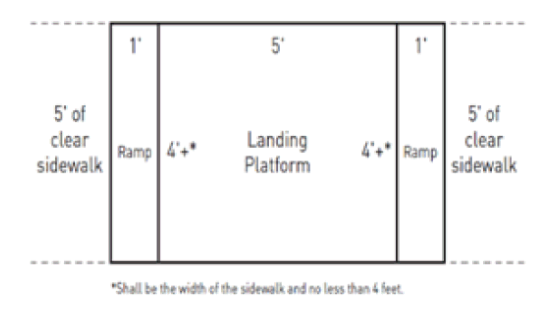
(5)EVSE and Charging Stations shall not create a trip hazard or compromise the accessible path of travel when the cord is connected to a vehicle, in accordance with the U.S. Access Board's guidance for Floors and Ground Surfaces (https:// www.access-board.gov/ada/guides/chapter3-floor-and-ground-surfaces/).
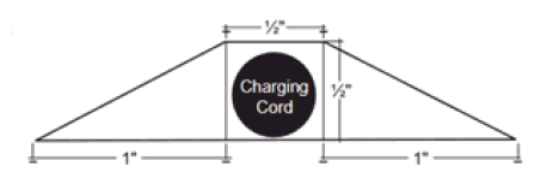
(a)Charging cords must be covered by a highly visible, stable, secure, lowangle cable ramp while charging.
(b)A cover should remain highly visible at night through the use of reflective tape or colors that contrast with adjacent walking surfaces.
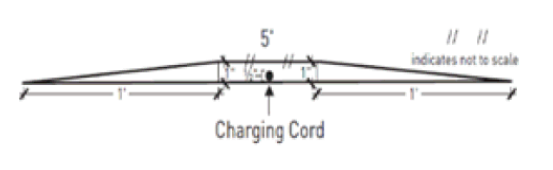
(c)If the total height of both the cord and the ramp does not exceed one half inch (1/2"), the following requirements apply:
(i)The ramp shall cover the charging cord completely across the sidewalk and be at least 4 feet in length.
(ii)The ramp shall be no steeper than a 50% grade or 1:2 gradient.
Figure 2. Cross-section of Ramp Requirements for Cords up to 1/2 inch.
101.9. ELECTRIC VEHICLE CHARGING INFRASTRUCTURE READINESS REQUIREMENT FOR NEW RESIDENTIAL CONSTRUCTION.
(a)All new Group R-3, single family, two-family, and three-unit dwellings occupancies shall provide EVSE to accommodate the future installation of Charging Stations.
(b)The following project types shall also comply with the EV Ready Residential Requirements established in this section:
(1)When a new Accessory Dwelling Unit (ADU) is constructed with a garage.
(2)When a service change is triggered for a detached garage.
(3)When an electrical service is changed or upgraded.
(c)EVSE shall be installed in accordance with the requirements of the current edition of the NEC and this section.
(d)All dwellings regulated by this section shall provide sufficient electrical capacity for a 9600 VA branch circuit for the future installation of EVSE. Each new residential unit shall provide an area within attached garages, carports, driveways, or detached garages for at least one EVSE Ready parking space. The EVSE Ready parking space shall include at least:
(1)A 240V electrical outlet, with a dedicated branch circuit capable of supporting, at a minimum, a Level-2 Charger;
(2)The electrical panel serving the residential unit shall have sufficient electrical load capacity and panel space for the installation of a dedicated branch circuit for the EVSE.
(3)The outlet shall be a National Electrical Manufacturers Association (NEMA) 14-50 or equivalent, ensuring compatibility with most Level-2 Chargers.
101.9
(4)The EVSE Ready parking space and the corresponding outlet or branch circuit shall be clearly labeled as "EVSE Ready" in the electrical panel and at the outlet location.
(5)A permanent label shall be affixed to the electrical panel indicating the location of the EVSE-Ready outlet and its circuit breaker.
(6)If a residential unit does not have an attached or detached garage, an underground electrical conduit shall be provided between the dwelling and the designated off-street parking space for the dwelling.
(7)The overcurrent protective device and the panelboard must be sized to accommodate the sum of the value noted in subsection (b) of this section, plus the demand factor for continuous duty established in the NEC.
(e)EVSE shall be designed, arranged, and installed to prevent damage and to prevent exposure to damage.
(d)The EVSE Ready parking space shall include a raceway, which is continuous from the branch circuit/feeder panel location to the future EV parking space designated for the dwelling. The raceway shall be sized and installed in accordance with the International Building Code and the following requirements:
(1)To accommodate the appropriate conductor size within the wall cavity to protect the conductors from harm. The EVSE infrastructure raceway shall include conduit and wiring for the dedicated branch circuit installation.
(2)The electrical load capacity for the service panel shall be provided on the permitting documents to ensure the service panel has adequate electrical load capacity. Utility companies shall be consulted to verify capacity concerns of overloading local transformers is possible.
(3)When a disconnect is required or EVSE Installed, the disconnect may be an aluminum conductor from the service panel to the disconnect. The conductor from the disconnect to the charging unit shall be copper conductors. (Ord. No. 2017-76(17-O-1654), § 2, 11-29-17; Ord. No. 2018-09(18-O-1143), § 2, 4-25-18; Ord. No. 2021-43(21-O-0618), § 2, 9-15-21; Ord. No. 2025-03(25-O-1011), § 2, 1-23-25)
101.10. SECURITY CAMERA INTEGRATION READINESS REQUIREMENT FOR NEW COMMERCIAL CONSTRUCTION.
(a)Definitions:
1.Integrable Security Camera System: An Integrable Security Camera System shall mean a video management system capable of producing a retrievable and identifiable image and that is able to connect to the City's Video Integration Center.
2.Integrable Security Infrastructure:
Camera
i.The wiring, conductors, connectors, attachment plugs, and all other fittings, devices, power outlets, or apparatus installed specifically for the purpose of transferring energy between the premises wiring and the Integrable Security Camera System;
ii.Any cables needed to install a Integrable Security Camera System including coaxial cable, fiber- optic cable, ethernet cable, or other appropriate cable, if necessary; or
iii.Any fixtures or poles needed to mount the Integrable Security Camera System's components.
3.Ingress/Egress Points: Shall mean main access points for the public to enter and exit a building or structure including access points for vehicles entering and exciting parking garages.
(b)All new construction of new occupancies of Assembly Group A buildings or structures (excluding places of religious worship), Business Group B buildings or structures, Institutional Group I 102.2 buildings or structures, Mercantile Group M buildings or structures, Residential Group R buildings or structures, and Storage Group S buildings or structures (including S-2 parking garages associated with other new occupancies), as regulated by the International Building Code, and that are 100,000 square feet or more, are required to install Integrable Security Camera Infrastructure. The Integrable Security Camera Infrastructure shall be installed per this code provision including that:
1.The Integrable Security Camera Infrastructure shall be installed on the exterior of the buildings or structures at Ingress/Egress Points; and
2.Prior to a final inspection, or at an appropriate point in the permitting process as determined by the Office of Buildings, the property owner, or authorized agent, shall execute an affidavit affirming compliance with the requirements of this code provision. The Office of Buildings shall have the administrative authority to determine the scope and terms of the affidavit and shall include wireless or wi-fi capable connections as compliant with this code provision.
(c)Nothing in this code provision shall require a building owner to connect a Integrable Security Camera System to the City's Video Integration Center however the Integrable Security Camera Infrastructure shall be installed to facilitate this connection should the building owner so choose. (Ord. No. 2023-34(23-O-1402), § 1, 10-2-23)
SECTION 102. DIRECTOR OF THE BUREAU OF BUILDINGS TO HAVE SUPERVISION, MAKE TESTS AND INSPECTIONS
102.1. CREATION OF DUTIES.
The Director of the Bureau of Buildings shall receive applications required by this Code, issue permits and furnish the prescribed certificates. The Director shall examine the equipment, appliance or system for which permits have been issued and shall make necessary inspections to see that the provisions of the law and this Code are met. The Director shall enforce all laws relating to the construction, alteration, repair, installation, erection, removal, demolition, use, location, and maintenance of equipment, appliances or systems, except as may be otherwise provided for in other ordinances or regulatory measures. The Director, when requested by proper authority, or when the interests of the City of Atlanta so require, shall make investigations in connection with matters referred to in this Code and render written reports on the same. To enforce compliance with law, to remove illegal or unsafe conditions or to secure the necessary safeguards, the Director shall issue such notices or orders as may be necessary.
102.2. INSPECTIONS REQUIRED.
(a)Inspections required under the provisions of this Code shall be made by the Director of the Bureau of Buildings or his duly authorized representatives. Upon presentation of proper credentials, the Director or his duly authorized representatives may enter, at reasonable times, any building, structure or premises in the City of Atlanta to perform any duty imposed by this Code. The Director of the Bureau of Buildings or authorized representatives are hereby authorized and directed to enforce all provisions of this Code, and are hereby invested with all police power necessary for the purpose of making arrests, issuing copies of charges and prosecution of any person or persons as may be charged with any violations of this or other ordinances of the City of Atlanta.
(b)All installations of any equipment, appliance or system for which a permit has been issued as prescribed in this Code shall be subject to inspection by the Director of the Bureau of Buildings or duly authorized representatives.
(c)The director or duly authorized representatives upon notification from the permit holder shall make such inspections as may be necessary, and shall either approve that portion of the construction as completed or shall notify the permit holder or agent wherein the same fails to comply with the law.
102.2
(d)It shall be unlawful for any person, firm or corporation, their agents or employees, to cover or conceal any electrical wiring until it has been inspected and approved.
(e)Electrical power shall not be turned on until final approval is granted by the Director of the Bureau of Buildings. This Section will not prevent the issuance of temporary approvals. Where electrical power has been turned on to any installation which violates this Code, the Director of the Bureau of Buildings may cause said electrical power to be immediately terminated.
(f)Failure to obtain a final inspection within 30 days of job completion or prior to tenant occupancy shall be a violation of this Code, unless otherwise approved.
102.3. RULES.
(a)The Director of the Bureau of Buildings shall promulgate rules as prescribed in this Code and consistent therewith. It being the intent of this requirement that the standards of federal and state bureaus, national technical organizations or fire underwriters, as the same may be amended from time to time, shall serve as a guide in establishing the minimum rules of practice under this Code.
(b)For the purpose of insuring public safety, materials, equipment, appliances, or systems intended for the use in the City of Atlanta for which conditions of use are not provided for in this code, the Director or duly authorized representatives shall make or cause to be made investigations, or may accept duly authenticated reports from recognized sources, from which rules will be set forth by the Director.
(c)No rule of the Director of the Bureau of Buildings shall become effective until four weeks after notice of intention to enforce it shall have been given through the publication in a newspaper in general circulation in the City of Atlanta and until a public hearing on the same shall have been held, provided that said public hearing shall not be necessary unless a request shall have been made for such hearing during the said period of publication, by notice to the Director of the Bureau of Buildings. Such rule must be drawn in its proposed form and open to public inspection at the time the notice to enforce is published.
102.4. RECORDS.
(a)The Director of the Bureau of Buildings shall keep comprehensive records of applications or permits issued, of inspections made, of reports rendered, and of notices or orders issued.
(b)All such records shall be open to public inspection for good and sufficient reasons at office hours observed by the City of Atlanta, but shall not be removed from the office of the Director of the Bureau of Buildings.
SECTION 103. APPLICATION FOR PERMIT
103.1. WHEN REQUIRED.
It shall be unlawful to construct, erect, install, alter or repair or to commence the construction, erection, installation, alteration or repair of any equipment, appliance or system provided for in this Code without first filing with the Director of the Bureau of Buildings an application in writing and obtaining a formal permit in conformity with Section 104.
EXCEPTION: 1. Emergency installations resulting from unexpected conditions which developed suddenly and required immediate action shall be exempt from this section for a maximum period of forty-eight (48) hours subject to approval of the Director of the Bureau of Buildings if telephoned to the Electrical Division.
103.2. APPLICATION FORM.
(a)An application for a permit shall be submitted in such form as the Director of the Bureau of Buildings may prescribe.
(b)Such application shall be made by the owner or the owner's authorized licensed representative. It shall be the responsibility of the owner to see that a permit is obtained by a licensed individual (See Section 103.4), before any installation or work is started.
(c)Such application shall contain the full names and addresses of the applicant and of the owner.
(d)Such application shall describe briefly the proposed work and shall give such additional information as may be required by the Director of the Bureau of Buildings for an intelligent understanding of the work.
103.3. PLANS AND SPECIFICATIONS.
(a)When required by the Director of the Bureau of Buildings, two or more copies of specifications and drawings to scale with sufficient clarity and detail to indicate the nature and character of 103.3 the work shall accompany every application. Such drawings and specifications shall contain name and address of designer and information in the form of notes or otherwise, as to the quality of materials, where quality is essential to conformity with this Code. Such information shall be specific, and this Code shall not be cited as a whole or in part, nor shall the term "legal" or its equivalent be used, as a substitute for specific information. The Director of the Bureau of Buildings may require details, computations, load studies and other data necessary to describe the construction and basis of calculations and they shall bear the signature of the person responsible for the design.
(b)It shall be unlawful for any private or commercial entity to engage in the construction of any work or structures involving professional engineering which by the nature of their function or existence could adversely affect or jeopardize the health, safety, or welfare of the public unless the plans and specifications have been prepared under the direct supervision or review of and bear the seal of, and the construction is executed under the direct supervision of or review by, a registered professional engineer or architect.
(c)Nothing in this section shall be held to apply to any construction, including alterations, of which the completed cost is less than $100,000.00 or which is used exclusively for private or noncommercial purposes, or to private residences, or to noncommercial farm buildings, or to residence buildings not exceeding two stories in height, excluding basements.
103.4. MANDATORY LICENSE REQUIREMENTS.
(a)Only partnerships or corporations engaged in the business of electrical contracting, installation or repairing shall be entitled to a permit under this Code for such business activities where there is regularly connected with such partnership or corporation a person or persons, actually engaged in the business of electrical contracting, installation or repairing, who holds a valid Electrical or Low-Voltage Contractor's License issued by the State of Georgia Construction Industry Licensing Board.
(b)Only a person engaged in the business of electrical contracting, installation or repairing shall be entitled to receive a permit under this Code for such business activities where such person holds a valid Electrical or Low-Voltage Contractor's License issued by the State of Georgia Construction Industry Licensing Board.
(c)All work requiring a permit under this Code shall be performed by an individual, firm, or corporation holding a valid business license in the City of Atlanta.
(d)It shall be unlawful for any person, firm or corporation who is not an Electrical contractor duly licensed by the State of Georgia to display a sign stating or implying that he or they are carrying on the business of this Code or fails to comply therewith or with any of the requirements thereof, shall be deemed guilty of an offense and upon conviction thereof, in the City of Atlanta Municipal Court, shall be assessed a fine of not less than $50.00 nor more than $1,000.00 and/or sentenced to no more than 60 days in the City Stockade. Where any offense continues from day to day, each day's continuance thereof shall be deemed a separate offense.
SECTION 104. PERMITS
104.1. ACTION ON APPLICATION.
(a)In accordance with Section 103.4 (Mandatory License Requirements), applications for permits shall be examined, within a reasonable time after filing. If, after examination, no objection is found to the same and it appears that the proposed work will be in compliance with the laws and ordinances applicable thereto, the application shall be approved and a permit issued for the proposed work. If examination reveals otherwise, such applications shall be rejected, and the applicant notified by a written report or otherwise informed.
(b)The issuance or granting of a permit or approval of plans and specifications shall not be construed to be a permit for, or an approval of any violation of any of the provisions of this Code.
(c)The issuance of a permit based on applications, plans and/or specifications shall not prevent the Director of the Bureau of Buildings from thereafter requiring the correction of errors in said applications, plans and/or specifications or from preventing the work from being carried on thereunder when in violation of this Code or of other ordinances of the City of Atlanta.
(d)No partnership or corporation engaged in the business of electrical contracting, installation or repairing shall be entitled to a permit under this Code for such business activities unless there is regularly connected with such partnership or corporation a person or persons actually engaged in the business of electrical contracting, installation or repairing who holds a valid State of Georgia Electrical or Low-Voltage Contracting License.
104.3. PERMITS REQUIRED UNDER THIS CODE AND FEE SCHEDULES.
The following equipment or systems are required to be permitted in accordance with this Code, and Table I, Permit Inspection Fee Schedule.
(a)Any person obtaining a permit shall pay to the City of Atlanta fees in accordance with Table I, City of Atlanta Electrical Division/Schedule of Permit Fees.
[Table I not available for printing. See Director, Bureau of Buildings]
(b)Any person obtaining a permit shall pay to the City of Atlanta fees as follows:
1.Temporary Pole, each .
$50.00
2.Disconnect or reconnect of service . . . . . . . . . . . . .
50.00
3.Public Utility . . . . . . . . .
50.00
4.Change of Contractor .
50.00
5.Service/Disconnects: 1—200 amps, each . . . . 201—800 amps, each . .
(c)A reinspection fee of $50.00 shall be imposed for each reinspection after the initial inspection when a written notice has been issued requiring a correction of inferior work.
(d)In the event that any work under this code for which a permit is required is started without a permit first being obtained, the permit fee will be doubled for that permit. However, in no event shall the penalty portion of said fee exceed $1,000.00. In addition, if any work is found to have been performed which is not listed on an existing permit, the cost of adding that work to the permit shall be double the usual fee. However, in no instance shall the penalty portion of that fee exceed $1,000.00. (Ord. No. 1998-9, § 2, 2-16-98; Ord. No. 2002-11, § 2, 3-5-02; Ord. No. 2002-35, § 2, 5-28-02)
104.4. CONDITIONS OF PERMIT.
(a)All work performed under a permit issued shall conform to the approved application and plans and all codes or ordinances governing the work or equipment for which permits were issued. All work shall be performed by an individual, contractor, firm or corporation licensed to perform such work. Permits shall not be transferable except as provided in Section 104.7.
(b)Individuals, contractors, firms or corporations licensed to perform work governed by this Code shall register their Georgia State Electrical and/or Low Voltage Contractor's license number with the Director of the Bureau of Building before obtaining permits.
(c)One set of approved plans and specifications shall be retained by the director and one set of approved plans and specifications shall be returned to the applicant, which shall be kept on such building or work at all times during which the work authorized thereby is in progress.
104.5. EXPIRATION OF PERMIT.
A permit under which no work is commenced within six months after issuance, or where the work commenced is suspended or abandoned for six months, shall expire by limitation, and fees paid shall be forfeited. The application, plans, and specifications shall be reviewed and a new permit required before work is started or resumed.
104.6. REVOCATION OF PERMIT.
(a)The Director of the Bureau of Buildings may revoke a permit or approval, issued under the provisions of this Code, in case there have been any false statements or misrepresentation as to a material fact in the application or plans on which the permit or approval was based.
(b)Failure at any time to comply with the requirements of the City of Atlanta Electrical Code.
(c)Upon determination by the Director of the Bureau of Buildings that an electrical installation is unsafe and hazardous to life and safety.
(d)Failure to follow the plans and specifications on file with the Bureau of Buildings relative to a particular permit.
104.7. NEW CONTRACTOR OR ALTERNATE CONTRACTOR ON JOB.
(a)In the event that a contractor leaves or abandons a job to which a permit has been issued before the final inspection, that contractor remains responsible for any work on that job that is not in compliance with this Code.
(b)Any new contractor on any job which has not received final approval must apply for a new permit for all work on that job that has not been finalized and assumes all responsibility. A minimum fee permit of $30.00 shall be issued for the change of contractor.
104.8. REFUND OF PERMIT FEES.
Within six (6) months from the date of issuance of a permit, a refund request may be granted, as follows:
(a)When a permit has been issued in error as determined by the Director, the total fee may be refunded provided no work has commenced on that permit.
(b)When a permit has been issued and the job has been cancelled, 50% of the permit fee may be refunded provided no work has commenced on that permit.
(c)Any overpayment or refund request of $50.00 or less shall not be refunded.
(d)No refund shall be issued for less than $50.00 All applications for refunds shall be in writing and shall state the reasons for the request. (Ord. No. 1998-9, § 2, 2-16-98; Ord. No. 2002-11, § 2, 3-5-02)
104.9. TEMPORARY SERVICES.
Temporary electrical service may be installed at a location when proper forms have been submitted to the Chief Electrical Inspector for the following purposes:
(a)To supply power for the purpose of hoisting material used in buildings under construction or remodeling, and for the purpose of lighting said buildings or structures during the construction of said buildings.
(b)The lighting of tents or buildings used for temporary gatherings or performances where said tents or buildings will only be used for a short duration. In addition, temporary service may be installed where lighting is to be used for decorative purposes for a short duration.
(c)To allow electrical service to parts of wiring installations which have been made safe to the satisfaction of the Electrical Division so that the testing of certain electrical equipment may occur, and in order to allow tenants, leasees, or owners the use of certain completed parts of buildings before all the work is completed.
(d)The application for temporary service shall state the period of time the service is required and the necessity for same. No temporary approval shall be issued for a period of more than 90 days, except when specifically authorized, in writing, by the Director of the Bureau of Buildings. Requests for extensions shall be made in writing to the Electrical Division. It shall be made in writing by the person, firm or corporation holding the permit. Upon expiration of temporary approval, such service shall be immediately discontinued.
SECTION 105. UNSAFE SYSTEMS, APPLIANCES OR EQUIPMENT
105.1. UNSAFE SYSTEMS, APPLIANCES OR EQUIPMENT.
(a)Systems, appliances or equipment covered by this Code that may be or shall be found upon inspection to have become dangerous or unsafe, shall unless made safe and so certified by the Director of the Bureau of Buildings, shall be removed or the use of such equipment or systems discontinued.
(b)The term dangerous or unsafe systems, appliances or equipment shall include systems, appliances or equipment structurally unsafe, unstable or unsanitary; constituting a fire hazard, unsuitable or improper for the use to which they are put; constituting a hazard to health or safety because of inadequate maintenance, dilapidation or obsolescence; or otherwise dangerous to life or property.
105.2. NOTICE OF UNSAFE SYSTEMS, APPLIANCES OR EQUIPMENT.
(a)Upon receipt of information that systems, appliances or pieces of equipment covered by this Code are unsafe, the Director of the Bureau of Buildings shall make or cause to be made an inspection; and if it is found that an unsafe condition exists, shall serve or cause to be served on the owner, or any one of the owners, executors, administrators, agents, lessees or other persons who may have a vested or contingent interest in the same, a written notice containing a description of the particulars in which the systems, appliances or equipment are unsafe, and an order requiring the same to be made safe, as may be deemed necessary by him.
(b)If the person to whom such notice and order is addressed cannot be found, after diligent search, then such notice and order shall be sent by registered mail to the last known address of such person; and a copy of such notice shall be posted in a conspicuous place on the premises to which it relates. Such mailing and posting shall be deemed adequate notice.
105.3. DISREGARD OF NOTICE.
If a person served with a notice or order to remove existing unsafe conditions from systems, appliances or equipment or discontinue the use of same, should fail within a reasonable time as set by the Director of the Bureau of Buildings to comply with the requirements thereof, the Director of the Bureau of Buildings shall institute an appropriate action in the courts to compel a compliance and/or may cause the electrical power to be disconnected to the location to ensure safety.
SECTION 106. VIOLATIONS
106.1. NOTICE.
Whenever the Director of the Bureau of Buildings is satisfied that systems, appliances or equipment, or any work in connection therewith that is covered by this Code, is being erected, installed, altered or repaired in violation of the provisions or requirements of this code, or in violation of plans or specifications submitted and approved thereunder, or of a permit issued thereunder, a written notice or order shall be served by the Director upon the person responsible therefor directing discontinuance of such illegal action and the remedying of the condition that is in violation of the provisions or requirements of this Code.
106.2. STOPPING WORK.
(a)Whenever, in the opinion of the Director of the Bureau of Buildings, defective or illegal work in violation of a provision or requirement of this Code is in progress, he shall order, in writing or otherwise, such work to be stopped, and may require suspension of all work until the condition in violation has been corrected.
(b)The Director of the Bureau of Buildings shall have authority, after due notice, to cut off electrical power to any electric wiring equipment or appliance which, in his opinion, is unsafe to life or property and to require discontinuance of the same until the electric wiring, equipment or appliance is made safe in conformance with this Code.
107.2
106.3. PENALTIES.
(a)Any person who shall violate a provision of this Code or fails to comply therewith or with any of the requirements thereof shall be deemed guilty of an offense and upon conviction thereof shall be punished as provided in Section 18-1008 (General Penalty) of the Code of Ordinances of the City of Atlanta, which provides:
"Whenever in this code or in any ordinance of the city any act is prohibited or is made or declared to be lawful or an offense, or whenever in this code or ordinance the doing of any act is required or the failure to do any act is declared to be unlawful, where no specific penalty is provided therefor, the violation of a provision of this code or that ordinance shall be punished by a fine not to exceed $1,000.00 and costs or imprisonment in the city jail for not more than 60 days, or work on the public streets or on public works of the city for not more than 60 days, or by any one (1) or more of these punishments, subject to all limitations contained in the charter of the city. Each day any violation of this code or of any ordinance shall continue shall constitute a separate offense.
In addition to the penalties hereinabove provided, any condition caused or permitted to exist in violation of any of the provisions of this code or any ordinance shall be deemed a public nuisance and may be abated by the city as provided by law, and each day that the condition continues shall be regarded as a new and separate offense."
(b)The owner of a building, structure or premises, where anything in violation of this Code shall be placed or shall exist, and an architect, engineer, builder, contractor, agent, person or corporation employed in connection therewith who may have assisted in the commission of such violation shall each be guilty of a separate offense and upon conviction thereof shall be fined as herein provided.
(c)Any work performed after the issuance of a Stop Work Order shall be demolished promptly and completely at the expense of the responsible party. Demolition shall be carried out in accordance with applicable regulations and safety standards.
(d)No permits shall be issued for further construction, renovation, or alteration of the structure in question until it has been restored to its state as of the date the Stop Work Order was issued. (Ord. No. 2024-49(24-O-1093), § 2, 8-19-24)
106.4. ABATEMENT.
The imposition of the penalties herein prescribed shall not preclude the City of Atlanta from instituting an appropriate civil action or proceeding to prevent an unlawful erection, construction, reconstruction, alteration, repair, conversion, maintenance or use, or to restrain, correct or abate a violation, or to prevent the use of any equipment, appliance or system covered by this Code.
SECTION 107. ADVISORY BOARD
§ 1107.1 107.1. APPOINTMENT.
There is hereby created a Board to be known as the Electrical Advisory Board, consisting of five (5) members to be appointed by the Mayor and approved by the Council. Each member shall be either an engineer or contractor with not less than six (6) years experience in the field of heating and air conditioning. The Board will elect one of its members as Chairman. Five members of said Board shall constitute a quorum thereof for the transaction of any and all business properly coming before them. All terms shall be for a period of two (2) years, except that any term shall be automatically extended until such time as the Mayor appoints a successor.
107.2. RECORDS.
The Bureau of Buildings shall provide secretarial services to the Advisory Board and shall make a detailed record of all its proceedings, which shall set forth the reasons for the decisions and the vote of each member participating therein, the absence of a member, and the 107.2 failure of a member to vote. These records shall be submitted to the Board for their approval and then kept on file as a public record in the Bureau of Buildings.
107.3. PROCEDURE.
The Board shall establish rules and regulations for its own procedure not inconsistent with the provisions of this Code. The Board shall meet at regular intervals, to be determined by the Chairman, or in any event, the Board shall meet within ten (10) days after notice of appeal has been received.
107.4. APPEALS.
Whenever any person shall be dissatisfied with any ruling, decision or order of the Director of the Bureau of Buildings, such person may make a written request to the Chairman of the Advisory Board for a hearing thereon. The Chairman of the Board shall thereupon call the Board to meet to hear and investigate such complaints. After a full and complete hearing on all questions in controversy, the Advisory Board shall render its opinion, concurring in, or recommending such changes in the order, ruling or decision of the Director of the Bureau of Buildings as it may deem fit or proper under the circumstances. Each action of the Board shall be by resolution, copies of which shall be certified to the Director of the Bureau of Buildings and the complaining party or parties. When the Director of the Bureau of Buildings has a question relating to any matter affecting this Code, the Director may call for the Board to meet to advise the Bureau on the problem.
107.5. EXPENSE TO APPELLANT.
Any appellant, or complaining party requesting a hearing before the Advisory Board shall pay the sum of Fifty ($50.00) Dollars to the City of Atlanta.
107.6. COMPENSATION.
Each member of the Advisory Board shall be paid Twenty-Five ($25.00) Dollars by the City of Atlanta for each meeting attended by him.
108. LIABILITY.
This Code shall not be construed as imposing upon the City of Atlanta any liability or responsibility for damages to any person or property caused by any defect in the system, equipment, nor shall the City of Atlanta or any official or employee thereof, be held as assuming any such liability or responsibility by reason of the inspection authorized hereunder or the certificate of approval issued by the Inspector.
SECTION 2: That the National Electrical Code, 1990 (NFPA 70) be adopted except as amended herein.
SECTION 4: That Chapter 1, entitled General, and that Article 100, entitled Definitions, be amended by adding the following definitions:
Director: The Director of the Bureau of Buildings is the administrative authority to administer and enforce the provisions of this Code as adopted or amended.
Person: This shall include an individual, partnership, joint venture, association, corporation and any other legal entity recognized by the laws of the State of Georgia.
SECTION 5: That Chapter 5, entitled Special Occupancies, Article 517-17(a) be deleted in its entirety and inserting the following Section 517-17(a):
(a)Feeders. Where ground-fault protection is provided for operation of the service disconnecting means or feeder disconnecting means as specified by Section 230-95 or 215-10, an additional step of ground-fault protection shall be provided in the next level of feeder disconnecting means downstream toward the load. Such protection shall consist of overcurrent devices and current transformers or other equivalent protective equipment which shall cause the feeder disconnecting means to open.
SECTION 6: This ordinance shall become effective upon approval by the Mayor or upon becoming law without approval, except as to cases pending in any court, the previous Electrical Code of the City of Atlanta shall remain in full force and effect until those cases are finally determined.
SECTION 7: All ordinances and parts of ordinances in conflict with this ordinance are hereby repealed.