Chapter 16 — Supplementary Regulations for Specific Uses, Article 2 — COMMUNICATION TOWERS AND COMMUNICATION ANTENNA PERMITS
current as of 2026-04-02currency checked manuallyOfficialofficial source ↗8 sections · full chapter
§ 16-2.1
Purpose and Intent.
The purpose of this section is to establish guidelines for the siting of all wireless, microwave towers, common carrier towers, cellular, television and radio telecommunications towers and antennas. The regulations and requirements set forth herein are adopted for the following purposes:
(A)To provide for the location of communication towers and communication antennas in Forsyth County;
(B)To protect residential areas and land uses from potential adverse impacts of communication towers and antennas;
(C)To minimize adverse visual impacts of communication towers and antennas through careful design, siting, landscape screening and innovative camouflaging techniques;
(D)To accommodate the growing need for communication towers and antennas while minimizing the total number of towers within the community necessary to provide adequate personal wireless services to residents of Forsyth County;
(E)To promote and encourage shared use/co-location of existing and new communication towers as a primary option rather than construction of additional single-use towers;
(F)To consider public health, safety and welfare;
(G)To encourage the design and construction of towers and antennas to minimize adverse visual impacts;
(H)To avoid potential damage to adjacent properties from tower failure through engineering and careful siting of tower structures.
§ 16-2.2
Applicability.
(A)All new communication towers and communication antennas in Forsyth County shall be subject to these regulations and all other applicable regulations. For purposes of measurement, communication tower setbacks and separation distances as set forth in this Article shall be calculated and applied irrespective of County and municipal jurisdictional boundaries.
(B)All communication towers and communication antennas legally existing on February 8, 1999 shall be considered legal non-conforming uses, allowed to continue their usage as they presently exist: provided however, anything other than routine maintenance, including without limitation, structural modifications including provisions for additional antennas or additional providers and/or new construction on an existing communication tower, shall comply with the requirements of this Article with the exception of separation distances. Routine maintenance shall be permitted on such existing towers.
(C)The performance and construction standards provided for in this Article shall apply to all new communication tower construction including such construction that shall occur in areas zoned under the Commercial Tower zoning designation established by Ordinance 30J, now repealed.
(D)All government towers with public safety systems or equipment shall be exempt from the requirements of this subsection. However, private facilities and structures proposed for placement on governmentally owned property shall not be exempt.
(E)This ordinance shall not govern any tower, or the installation of any antenna, that is thirty five (35) feet or less in height and is owned and operated by a federally-licensed amateur radio station operator from the operator’s residence.
§ 16-2.3
General Requirements.
(A)Principal or Accessory Use. A tower and/or antenna is considered a principal use if located on any lot or parcel of land as the sole or primary structure, and is considered an accessory use if located on a lot or parcel shared with a different existing primary use or existing structure. An existing use or structure on the same lot or parcel shall not preclude the installation of an antenna or tower. For purposes of determining whether the installation of a tower or antenna complies with zoning district requirements, including but not limited to set-back, buffer and other requirements, the dimensions of an entire lot or parcel shall control, even though the antenna or tower may be located on a leased area within such lot or parcel. Towers that are constructed, and antennas that are installed, in accordance with the provisions of this ordinance shall not be deemed to constitute the expansion of a non-conforming use or structure.
(B)Inventory of Existing Sites. To facilitate the co-location of antennas, each applicant seeking to locate a new tower, alternative tower structure or antenna, or to modify any such existing structure, shall provide to the department an inventory of existing towers or alternative tower structures. Applicants seeking to erect an amateur radio tower or antenna as defined by Federal Communications Commission
(FCC)regulations, shall be exempt from this provision. The inventory shall include all such structures that are within the jurisdiction of the governing authority; within a municipality located, in whole or in part, within Forsyth County; and within a one mile border of Forsyth County, and shall include specific information about the location (latitude and longitude coordinates), height, design, tower type and general suitability for antenna co-location of each tower, and other pertinent information as may be required by the department. The department may share such information with other applicants for a Communication Tower permit under this Ordinance or other organizations seeking to locate towers or antennas within the jurisdiction of the governing authority, provided, however that the department is not, by sharing such information, in any way representing or warranting that such sites are available or suitable.
§ 16-2.4
Application Requirements.
(A)In addition to and in conjunction with the information required with a rezoning application, each application shall include a scaled site plan with topographical information, an elevation view, and other supporting drawings, calculations and documentation.
(B)The site plan must include setbacks, drives, parking, fencing, landscaping, adjacent uses, also the distances to all residences and schools, including daycare and nursery schools within 1000 feet, and any other information necessary to review the request.
(C)Documentation of radio frequency range, coverage area, and tower height requirements.
(D)Location and height of all existing towers owned by the applicant inside of and within one mile of the boundary of Forsyth County.
(E)New freestanding communication towers and communication antennas shall not be allowed unless the applicant makes an affirmative showing based on competent substantial evidence that:
(1)Existing towers and buildings do not technologically afford the applicant the ability to provide service to the service area of the applicant or service provider, or the cost or contractual provisions required by a tower owner to share an existing tower or structure or to adapt an existing tower or structure for sharing are unreasonable, and
(2)The geographical boundaries of the proposed service area cannot technologically be bifurcated to avoid the necessity for a freestanding tower/antenna, and
(3)There exists a present demand and formal commitment by wireless services providers to locate at the proposed site.
§ 16-2.5
Zoning Requirements.
Communication towers and communication antennas are considered conditional uses and upon proper application and approval may be permitted in zoning districts as specified in the Permitted Uses tables found in the individual zoning district chapters of this Code.
§ 16-2.6
Performance and Construction Standards.
(A)Structural Design. New Communication towers/antennas and modifications to existing structures including, without limitation, the addition of height, antennas or providers shall be constructed in accordance with all applicable County Building Codes and shall meet or exceed current standards and regulations of all applicable Federal, State and Local authorities. Lattice tower structures are prohibited.
(B)Setbacks. Communication tower/antenna setbacks shall be measured from the base of the tower/antenna or protruding building structure at the base of the tower, whichever is closest to the property line, to the property line of the parcel on which it is located. Communication towers/antennas and their accessory structures shall comply with the minimum lot and setback requirements of the district in which they are located. In cases where there is a conflict between the minimum lot setback and street setback requirements, the greater setback shall apply. Guy wires and support anchors are not required to meet setbacks, however they shall not extend outside of the property line and must be contained within the fenced area of the tower site.
(C)Separation from Residential Uses. Separation requirements for communication towers from residentially zoned lands or residential uses shall be a minimum of 500 linear feet. Communication tower separation shall be measured from the base of the tower to the closest point of off-site uses.
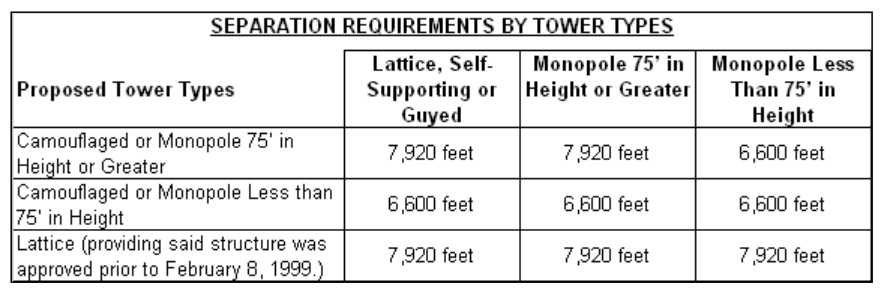
(D)Separation Distances Between Communication Towers. Separation distances between communication towers shall be applicable for and measured between the proposed tower and those towers that are existing and/or have received land use or building permit approval from the County. The separation distances shall be measured by drawing or following a straight line between the base of the existing tower and the proposed base, pursuant to a site plan, of the proposed tower. Minimum separation distances (listed in linear feet) shall be as follows:
(E)Fencing. A chain link fence or wall not less than six (6) feet in height, from finished grade equipped with an appropriate anti-climbing device shall be provided around each communication tower. Access to the tower shall be through a locked gate.
(F)Landscaping. The visual impacts of a communication tower shall be mitigated by landscaping. Where adequate vegetation is not present, tower facilities shall be landscaped with a landscape buffer which effectively screens the view of the tower compound. The use of existing vegetation shall be preserved to the maximum extent practicable and may be used as a substitute for or in supplement towards meeting landscaping requirements.
(1)Landscape buffers shall be a minimum of ten (10) feet in width and located outside the fenced perimeter of the tower compound; and
(2)A continuous hedge at least thirty (30) inches high at planting and capable of growing to at least thirty-six (36) inches in height within eighteen (18) months shall be planted in front of the above referenced buffer; and
(3)All landscaping shall be of the evergreen variety and shall conform with the buffer standards available for inspection at the department.
(G)Height.
(1)No freestanding communication tower/antenna shall exceed 200 feet in height from ground level.
(2)Where installed on top of a building, no communication tower/antenna shall extend greater than 20% over the building height.
(3)An existing communication tower may be modified to a taller height not to exceed 20 feet over the tower’s existing height to accommodate the co-location of an additional communication antenna(s).
(a)The height change referred to in this subsection may only occur one time per communication tower.
(b)The additional height referred to in this subsection shall not require an additional distance separation. The communication tower premodification height shall be used to calculate such distance separations.
(H)Illumination. Communication towers/antennas shall not be artificially lighted except to assure human safety or as required by the Federal Aviation Administration.
(I)Co-location. Proposed communication antennas may and are encouraged to co-locate onto existing communication towers, provided such co-location is accomplished in a manner consistent with zoning and performance standards, new or additional conditional use approval is not required. If it is determined by the County that the proposed tower is situated in a location which will benefit the County’s telecommunication systems, then the tower shall be engineered and constructed to accommodate the additional telecommunication equipment beneficial to the public system at a cost to the County no greater than the actual expense of the provider in so engineering and constructing the tower to meet the County’s needs.
(1)Monopole communication towers shall be engineered and constructed to accommodate a minimum of one additional communication service provider.
(2)Lattice communication towers that were approved but not yet constructed prior to effective date of this Code shall be engineered and constructed to accommodate a minimum of two additional communication service providers.
(3)Camouflaged communication towers may be engineered and constructed without accommodating additional communication service providers.
(4)Communication towers located within electrical substations may be engineered and constructed without accommodating additional communication service providers. Such towers shall be monopole construction and shall be subject to all of the requirements of Article II, Communication Tower and Communication Antenna Permits.
(J)Noninterference. No communication tower or antenna shall interfere with public safety communication. Frequency coordination is required to ensure noninterference with public safety system and/or public safety entities.
(K)Documentation. Documentation to demonstrate conformance with the requirements of Performance Standards shall be submitted by the applicant with all requests to construct locate or modify a communication tower/antenna. A statement by the applicant as to how construction of the communication tower will accommodate co-location of additional antennas for future users shall be included with the documentation. Documentation evidencing a present commitment from service providers to locate at the proposed site shall also be included by applicant. Documentation demonstrating proof of appropriate liability insurance shall also be provided.
(L)Signs and Advertising. A small sign placed on the entrance gate of sufficient size, not to exceed four
(4)feet in total area shall display the name of the person or corporation owning the tower, the name of the person or corporation owning the property (if different from tower owner) and a current mailing address with a name and phone number of a person to contact in case of an emergency. All other signage is prohibited and the use of any portion of a tower for sign or advertising purposes including, without limitation, company name, banners, or streamers, is prohibited.
(M)Abandonment. Without waiving the County’s right to determine whether or not a communication tower has been abandoned, it shall be the joint duty of both the property owner and tower owner to notify the County in writing of any intent to abandon use of the tower. Said notice shall include steps that tower and/or property owner shall take to accomplish removal of the tower structures. In the event the use of any communication tower has been discontinued for a period of 180 consecutive days, the tower shall be deemed to have been abandoned. Upon such abandonment, the owner/operator of the tower shall have an additional 180 days within which to: (1) reactivate the use of the tower or transfer the tower to another owner/operator who makes actual use of the tower; or (2) dismantle and remove the tower. The Owner of the real property shall be ultimately responsible for all costs of dismantling and removal and in the event the tower is not removed within 180 days of abandonment, the County may proceed to do so and assess the costs against the real property. The lien of such assessment shall bear interest, have priority and be collectable at the same rate and in the like manner as provided for by Georgia law. At the earlier of 181 days from the date of abandonment without reactivation or upon completion of dismantling and removal, any conditional use permit, waiver and/or variance approval for the tower shall automatically expire.
(N)Finished Color. Communication towers not requiring FAA painting/marking shall have either galvanized finish or be painted a non-contrasting blue, gray or black finish. The color should be selected so as to minimize the equipment’s visibility.
(O)Liability Insurance. Liability insurance in an amount not less than $1,000,000 shall be maintained by the owner and operator of the facility until such facility is dismantled and removed from the parent site.
Failure to maintain insurance coverage shall constitute a violation of this Code and grounds for revocation of conditional use approval. Proof of same shall be supplied to the department upon application.
(P)Fees.
(1)The fees for conditional use approval for a communication tower/antenna shall be the same as rezoning fees for the CBD category.
(2)The development permit fees shall be the same as for any commercial development.
(3)The building permit fees shall be set at $200.00 and shall cover the tower and associated equipment building. Any other permits required shall be charged at the prescribed rate at the time of development or construction.
(4)As with any conditional use or special exception application, the applicant shall be required to submit additional amounts as deemed sufficient and appropriate by the County in order to obtain any needed technological expertise so as to assist County staff in evaluation the request.
§ 16-2.7
Variance.
Any request for variance from the provisions of this article shall be presented directly to the Forsyth County Board of Commissioners.
§ 16-2.8
Notwithstanding any other provision of this Article, the installation, maintenance, and op
16-2.8 Notwithstanding any other provision of this Article, the installation, maintenance, and operation of
antennas and other associated equipment of the type commonly known as small cell communications equipment (“Small Cell Wireless Communications Equipment”) shall be governed by the Master Right of Way Agreement for Mini Cell adopted by the Board of Commissioners and/or the Small Wireless Facilities and Antennas Ordinance, as applicable, unless otherwise required by law.